


The Department of Health and Social Care has worked in partnership with NHS England and NHS Supply Chain to develop national guidance for the procurement of medtech. It applies to devices and associated services across primary and secondary care and is to be used at the quality assessment stage.
The aim is clear: to move procurement away from upfront price and towards whole pathway value, long-term outcomes and system benefits.
What does the guidance do?
The guidance introduces a standardised framework for assessing value at the quality stage of procurements. Value is assessed across five domains:
- Social value - aligns to PPN 002 and the NHS Social Value Playbook - outcomes on carbon emissions, packaging, product usage and modern slavery risks
- Efficiency - covers impact on pathways, productivity and measurable benefits
- Patient and staff - targets improved experience, outcomes, safety and reduced inequalities
- Supply chain - focuses on resilience, interoperability and circular economy
- Purpose - tests compliance, usability, implementation, training and support
These are then considered alongside whole-life cost, including purchase, implementation, operation and disposal.
A useful diagram setting out the weightings of each domain can be found in the guidance, as replicated below:
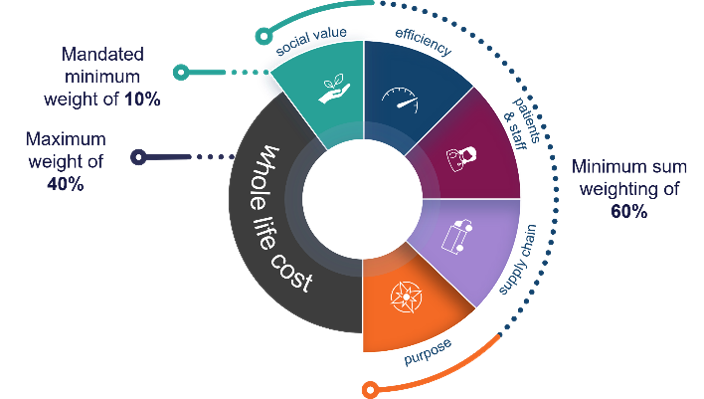
Buyers then select relevant domain questions and use a five-point scoring scale to guide evaluation quality from "outstanding" to "no response".
What does this mean in practice?
For NHS procurement and clinical teams, this is more than just a new scoring model.
1. Expect more structured (and potentially more complex) evaluations. You will need to:
- Select relevant value domains and questions for each procurement
- Ensure scoring remains proportionate to the size and complexity of the contract
- Clearly explain evaluation criteria to bidders
2. Early thinking about outcomes is critical. The model depends on being able to:
- Define measurable benefits upfront
- Identify appropriate data sources and baseline
- Align stakeholders (clinical, operational, finance) around what “value” looks like
3. Suppliers will need to evidence impact, not just describe it. Expect more detailed tender responses on:
- Pathway impact and patient outcomes
- Productivity gains
- Environmental and supply chain credentials
Key takeaways
- The guidance is designed to be used specifically during the quality assessment phase of the procurement process - it does not prescribe the entire procurement process
- NHS buyers are explicitly advised to seek legal assurance that the application of this guidance complies with the Procurement Act 2023 and, where relevant, The Health Care Services (Provider Selection Regime) Regulations 2023
- AI and digital products are firmly in scope
Join our webinar: A Practical Roadmap for Procuring Clinical AI
We are hosting a webinar on Thursday 25 June: Roadmap for the effective procurement of clinical AI which will be of interest to NHS buyers procuring clinical AI.
The Government’s 10 Year Health Plan sets out an ambition to make the NHS the most AI-enabled health system in the world. But realising that ambition depends on getting the procurement right.
In this session, our regulatory and procurement experts will cover:
- Key legal and regulatory risks in clinical AI procurement
- How to build these into your process from the outset
- A practical, step-by-step roadmap for successful procurement
- Common pitfalls and how to avoid them
There will also be an opportunity to ask questions and discuss your own challenges. Please let us know if you would like to attend.


