


Defamation law in Ireland has undergone significant shifts over the past decade, with litigation trends revealing a dramatic change in where and how claims are pursued. Against this backdrop, the Defamation (Amendment) Bill 2024 promises the most substantial reforms since the Defamation Act 2009. As we look back on recent developments and notable cases from 2025, we explore key trends, legislative changes, and what they mean for the future of defamation litigation in Ireland.
Trends in defamation: 2014 - 2024
The Defamation (Amendment) Bill 2024
Defamation Litigation – a look back at 2025
Trends in defamation: 2014-2024
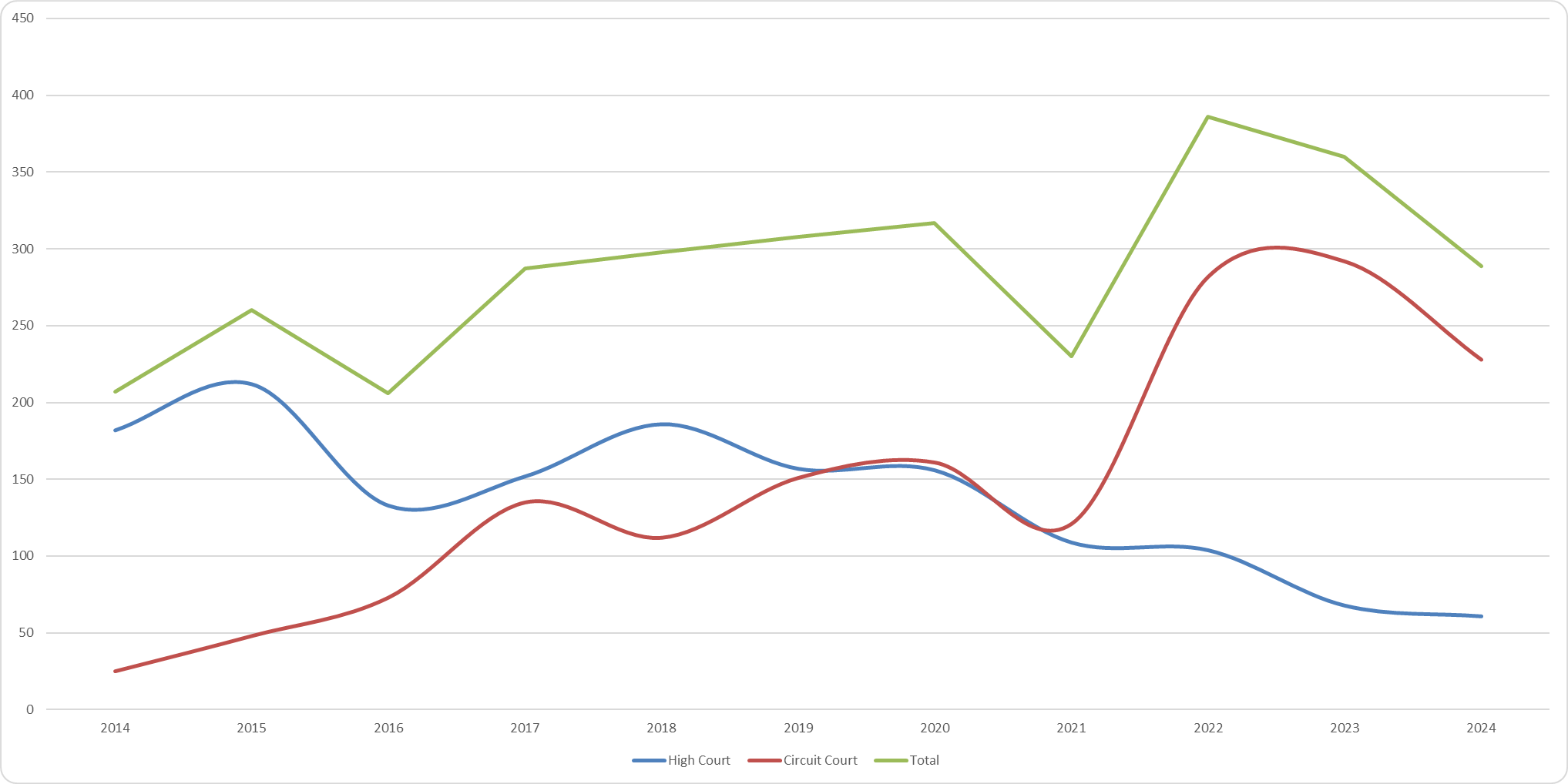
Each year, the Courts Service publishes key data on the number of new claims issued across different areas of law. We have delved into the archives to take a look back at the last decade in defamation claims.
|
|
2014 |
2015 |
2016 |
2017 | 2018 | 2019 | 2020 | 2021 | 2022 | 2023 | 2024 |
|
High Court |
182 |
212 |
133 |
152 | 186 | 157 | 156 | 109 | 104 | 68 | 61 |
|
Circuit Court |
25 |
48 |
73 |
135 | 112 | 151 | 161 | 121 | 282 | 292 | 228 |
|
Total |
207 |
260 |
206 |
287 | 298 | 308 | 317 | 230 | 386 | 360 | 289 |
- There has been a steady decline in the number of new High Court defamation claims, from a peak of 212 in 2015 to 61 in 2024, a 71% decrease.
- The High Court decline has been offset by dramatic growth in the Circuit Court, with claims jumping from just 25 in 2014 to 228 in 2024, an 812% increase.
The huge shift from the High Court to the Circuit Court is no doubt down to a range of factors including:
- The increase in the monetary jurisdiction of the Circuit Court in February 2014 from €38,000 to €75,000
- The guidelines for damages set out by the Supreme Court in Higgins v Irish Aviation Authority[2022] IESC 13 in 2022, which mean more defamation cases are likely to be deemed at the outset to fall within the Circuit Court jurisdiction
- The Circuit Court is a quicker, less costly and more consistent forum, not least because jury trials are only permitted in High Court defamation cases.
While the overall number of defamation cases issued in Ireland rose by approximately 40% over the past decade, the reasons behind this increase are less clear. What stands out most is how disproportionate Ireland’s figures are compared to England and Wales. In 2023, 360 defamation cases were issued in Ireland (down slightly from a peak of 386 in 2022), whereas England and Wales recorded just 250 cases – despite having a population nearly 12 times larger. On a per-capita basis, Ireland’s rate of defamation litigation is roughly 20 times higher.
One key factor is the difference in statutory thresholds. In England and Wales, the statute governing defamation provides that a statement is not defamatory unless its publication has caused or is likely to cause serious harm to the person's reputation, whereas in Ireland a statement is defamatory where it "tends to injure a person’s reputation in the eyes of reasonable members of society".
This is a considerably lower threshold which arguably lends itself to a higher volume of claims, including those involving relatively minor types of defamation, as evidenced by the large number of claims taken in the Circuit Court where the monetary jurisdiction is lower.
Notably, the Government’s proposed Defamation (Amendment) Bill 2024 does not seek to raise this threshold for individual plaintiffs, focusing instead on corporate claimants. Whether these reforms will meaningfully reduce Ireland’s high litigation rates remains to be seen. The proposed Bill is outlined below.
The Defamation (Amendment) Bill 2024
The law on defamation in Ireland is governed by the Defamation Act 2009. The Act was supposed to have been reviewed within the first five or six years of coming into force, but ultimately the review process did not commence until 2016 and eventually culminated in the publication of the Defamation (Amendment) Bill 2024, which sets out a series of proposed reforms.
The Bill lapsed when the previous government was dissolved, but has since been restored to the legislative agenda. It is currently at Committee Stage before the Seanad and proposes a number of reforms, including:
- The abolition of juries in High Court defamation claims, bringing the High Court in line with the existing procedure in the Circuit Court, where cases are heard by a judge only. The purpose of this reform is to reduce disproportionate and unpredictable awards of damages, as well as to reduce the length and cost of trials.
- Upgrading the existing requirements regarding offers of amends/correction orders. Currently, a correction and apology must be published by a defendant "in such a manner as is reasonable and practicable in the circumstances". The proposed changes state that defendants must publish a correction or apology with the same prominence as the original defamatory statement.
- Enhanced safeguards against Strategic Litigation Against Public Participation ("SLAPP") lawsuits, which are claims intended to stifle legitimate freedom of expression. The proposed provisions mirror those in the EU anti-SLAPP Directive, which must be transposed into Irish law by May 2026. The Bill sets out a non-exhaustive list of behaviours which might constitute a SLAPP, such as:
- A claim that is of a disproportionate, excessive or unreasonable nature
- Multiple proceedings initiated in relation to similar matters
- Bad faith procedural tactics, such as forum shopping
In those circumstances, a plaintiff could apply to the court for an order striking out the claim as being manifestly unfounded and declaring that the proceedings amount to a SLAPP.
- The introduction of a new higher threshold whereby a corporate plaintiff must demonstrate that it has suffered (or is likely to suffer) serious harm as a result of the defamatory statement, and that the harm is likely to result in serious financial loss.
It is expected that the Bill will be passed into law in the coming months and, if so, it will represent the biggest change to defamation law in Ireland since 2009. The reform measures are welcome, but some observers might question whether they go far enough. For example, the proposal to abolish juries in the High Court is a sensible one, but its impact will be limited considering that nearly 80% of defamation litigation takes place in the Circuit Court.
Similarly, the introduction of a "serious harm" threshold for corporate plaintiffs is welcome, but will have limited effect given that the majority of plaintiffs are natural persons. It remains to be seen whether these reforms will have any appreciable impact on the volume of defamation litigation in Ireland, which is already far in excess of neighbouring jurisdictions.
Defamation Litigation – a look back at 2025
There have been a number of interesting court decisions this year in the sphere of defamation.
Eric Swift / Lidl and RFC Security
We welcomed news of a case decided by Judge Geoffrey Shannon in the Circuit Court earlier this year. Eric Swift took defamation proceedings against Lidl and RFC Security arising out of a shopping trip in May 2023.
- Mr Swift had picked up a bottle of wine and put it into his bag, but had later returned it to the shelf before leaving the shop. He alleged a security guard approached him in the carpark and loudly declared that he would have to return to the supermarket on suspicion of theft.
- The defendants gave evidence that the security guard had seen Mr Swift putting the wine into his bag but had not seen him return it to the shelf.
- They admitted that the guard had asked Mr Swift to return to the store but they claimed the request had been made discreetly, that the security guard did not allege theft, and that the shop was protected by the defence of qualified privilege.
- Judge Shannon dismissed Mr Swift’s claim, saying that shopkeepers have a legal right to protect their property, accepting that the remarks made to Mr Swift were protected by qualified privilege in that they had not been made with malice.
The Casualty, Motor and Property team at DAC Beachcroft deals with a significant number of retail defamation claims each year. The exposure to legal costs in defending these claims is very often so disproportionate to the potential damages that defendants have no reasonable option but to settle on a commercial basis. We therefore welcome this decision and hope that it signals a changing tide in retail defamation litigation.
Two judgments of the High Court earlier this year have provided further guidance on the appropriate metrics for the assessment of damages in the context of defamatory online posts. Both judgments, were delivered in default of appearance and illustrate the High Court applying the damages guidelines set out by the Supreme Court in Higgins v the Irish Aviation Authority [2022] IESC 13 in 2022.
Casey -v- McMenamin
In Casey -v- McMenamin [2024] IEHC 705, the plaintiff was Peter Casey, a well-known businessman and former presidential candidate.
- Mr Casey sought damages for defamatory Facebook posts published by the defendant, Kim McMenamin, which alleged that Mr Casey was involved in human trafficking in the context of his efforts to house Ukrainian refugees in Donegal.
- The court found that these unfounded claims severely harmed Mr Casey's reputation. Mr Casey was awarded €120,000 in general damages ("medium defamation" under the guidelines laid down in Higgins).
- He was awarded an additional €20,000 in aggravated damages in light of the defendant's refusal to remove the posts despite legal requests and a court order.
Stillorgan Gas Heating and Plumbing -v- James and Julie Manning
In Stillorgan Gas Heating and Plumbing -v- James and Julie Manning [2025] IEHC 90, the plaintiff company sought damages in respect of negative reviews posted online on platforms such as Google and Trustpilot.
- There had been a legitimate dispute between the parties in relation to services provided by the company to the defendants. However, the reviews included statements describing the company as “gangsters”, “cowboys”, “absolute con men”, and falsely claiming that the company was under investigation by the Gardai for theft.
- The court accepted that the statements were defamatory and awarded the company €40,000 in general damages ("moderate defamation" under the guidelines laid down in Higgins).
- The relatively short period of time for which the reviews were posted (two were removed after 24 hours and the others after four days) was indicated by the court to have been an important factor in the assessment of damages and in the decision not to make an award of aggravated or punitive damages.


